
What is a potentiostat and how does it work?
Three-electrode cell, control amplifier and current measurement: the operating principle of the potentiostat/galvanostat and the criteria for choosing one.
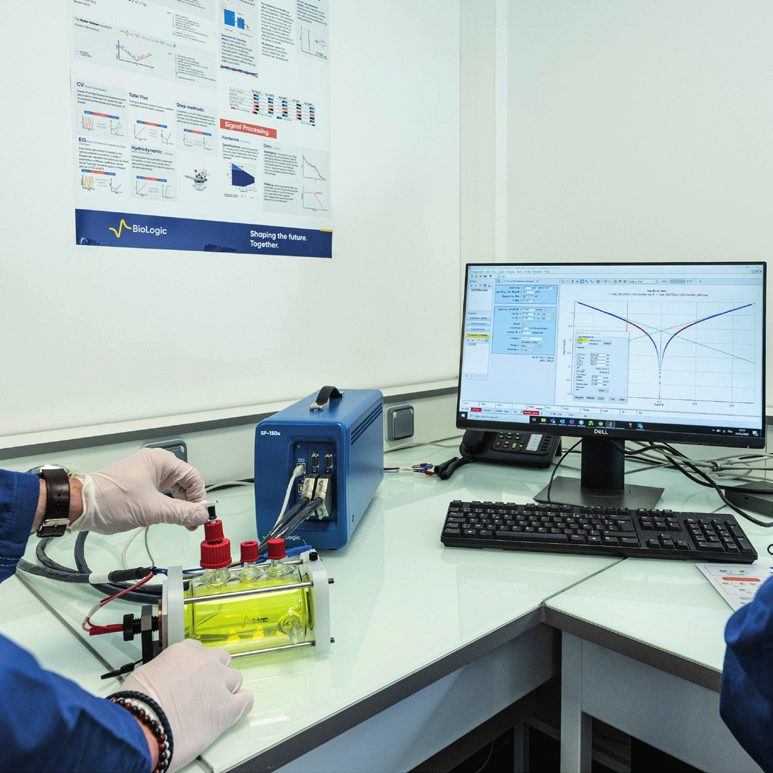
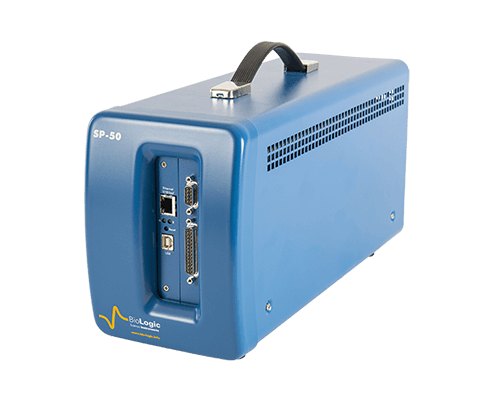
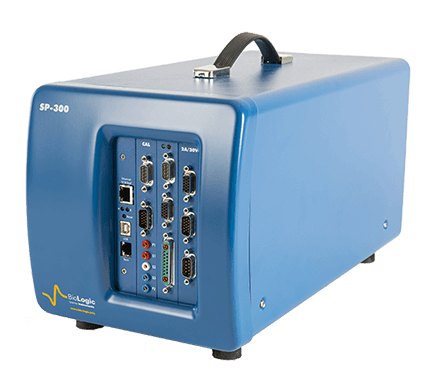
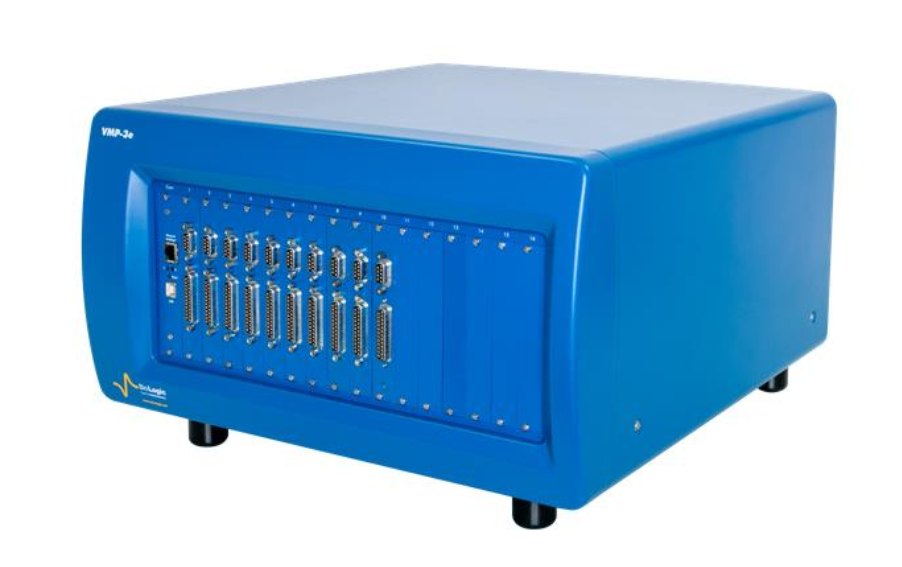
A potentiostat is an electronic control instrument that holds the potential of the working electrode (WE) of an electrochemical cell at the desired value relative to the reference electrode (RE) and supplies the current required to do so through the counter electrode (CE). In galvanostat mode the current is controlled and the potential is measured. Modern instruments (for example the Bio-Logic SP-300 or VMP-3e) offer both modes in the same hardware.
The three-electrode setup
Because no current flows through the reference electrode, its potential is stable; the potentiostat measures the potential difference between WE and RE with a high-input-impedance circuit (1 TΩ and above), and the control amplifier adjusts the voltage applied to the CE until the target potential is maintained. Current is measured with a current-to-voltage converter in the WE circuit. A large number of current ranges (13 ranges, 1 pA – 1 A, on Bio-Logic Premium instruments) allows both nA- and A-level currents to be measured accurately.
Which specifications matter?
Depending on your application, the decisive specifications are: compliance voltage (the maximum voltage that can be applied to the CE in high-resistance cells), maximum current and booster options, the lowest current range and its accuracy (for sensors and corrosion), bandwidth and rise time (for fast kinetics), EIS frequency range, number of channels and floating mode (for grounded cells and autoclaves).
Essential or Premium?
The Bio-Logic Essential range (SP-50e, SP-150e, VSP, VSP-3e, VMP-3e), with ±1 A standard current, 1 MHz EIS and 20 µs acquisition time, is the workhorse for general electrochemistry and energy research. The Premium range (SP-200, SP-300, VSP-300, VMP-300), with 11 MHz EIS, ULC down to 100 fA, hardware filters, floating mode and 1 µs sampling (ARG), is for researchers targeting the most sensitive and fastest measurements.
Sources: Bio-Logic 2026 product catalogue and product brochures; general electrochemistry literature. This content is for information; consult our technical team for instrument selection.