

What are SECM, SKP, SVET and LEIS? Which technique for which question?
1 Theory
Why local measurement?
Classical electrochemistry measures the average of the electrode surface; in corrosion, catalysis and biological systems, however, activity is heterogeneous at the micrometre scale (grain boundaries, coating defects, catalyst particles, cells). Scanning probe electrochemistry maps the electrochemical quantity against position by scanning a micro-sized probe over the surface.
SECM
Scanning electrochemical microscopy measures the diffusion-limited current of a mediator species (e.g. ferricyanide) in solution at an ultramicroelectrode (UME, 1–25 µm) tip. In 'feedback' mode a conducting surface regenerates the mediator and increases the current (positive), an insulating surface hinders diffusion and decreases it (negative); approach curves give the tip–surface distance and the surface kinetics. In 'generation/collection' mode the species produced at the surface is detected at the tip. Intermittent-contact (ic-SECM) and alternating-current (ac-SECM) modes separate topography from activity; resolution is limited by tip diameter and distance.
SKP, SVET and LEIS
The scanning Kelvin probe (SKP) measures the work function/Volta potential of the surface with a vibrating probe, contactless and without electrolyte (including humid air); it is related to the corrosion potential and maps under-coating corrosion and delamination. The scanning vibrating electrode technique (SVET) measures the local ionic current density with a probe vibrating in solution; it images anodic and cathodic regions (pits, galvanic couples) in real time. Localised EIS (LEIS) measures the local impedance with a two-terminal probe and maps coating defects with frequency information.
Which technique for which question?
'Where does corrosion start?' → SVET (in solution) or SKP (atmospheric). 'Is this region electrochemically active, what is its kinetics?' → SECM. 'Where is the coating weak?' → LEIS, SKP. 'Li activity at particle scale on a battery electrode?' → SECM (with a suitable mediator). 'Catalyst particle activity?' → SECM (generation/collection). When the techniques are combined on the same platform, topography (OSP/ic modes) and electrochemistry are obtained simultaneously.
2 Application in measurement
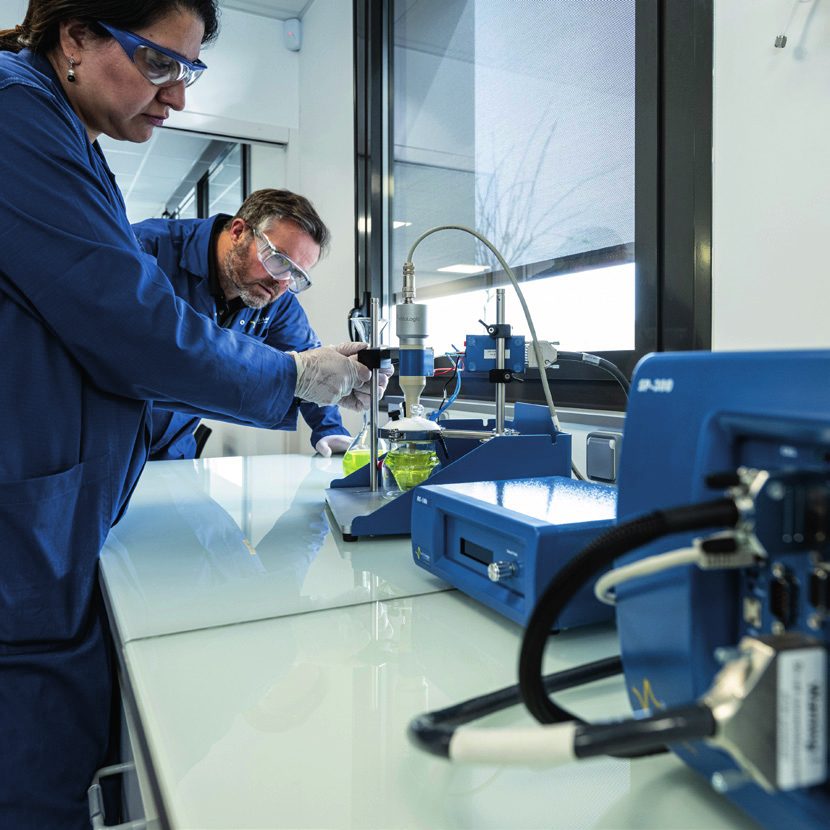
In SECM a microelectrode probe is held close to the surface and the current of a redox mediator (feedback) or of a species generated at the surface (generation/collection) is mapped; ac-SECM needs no mediator, ic-SECM follows the topography at the same time. SKP measures the surface potential (work function/corrosion potential) without contact; SVET provides local ion fluxes in the electrolyte, LEIS local impedance, SDS classical electrochemistry inside a droplet.
Application areas: localised corrosion and coating defects, battery electrode heterogeneity, catalyst and sensor activity maps, biological samples. The M470 platform offers these techniques in a single system with 20 nm positioning resolution; it is the current counterpart of the M370 and SECM150 mentioned in the notes.
Data processing: tilt correction, height tracking (OSP, ic mode), 3D visualisation (3DIsoPlot) and image analysis (MIRA).
3 Applicability
Where it applies
- Localised corrosion and coating defects, galvanic couples, catalyst and battery electrode heterogeneity, biological/cell-culture activity, micro-sensor characterisation.
Limits and caveats
- Control of the probe–surface distance is essential for quantitative results; without topography correction the images can mislead.
- Scanning is slow (minutes–hours); for fast-changing processes line scans or fixed-point monitoring are preferred.
4 What did the application notes find?
- Scanning Probes AN1 — Shows the effect of height tracking on signal quality in the SKP module; how keeping the probe at a constant distance from the surface improves measurement reproducibility.
- Scanning Probes AN2 — Shows the application of the topography obtained by optical surface profiling (OSP) to the SECM scan; obtaining the true activity map by height correction on a corrosion sample.
- Scanning Probes AN6 — Shows that intermittent-contact SECM excludes the topography contribution in two corrosion examples and its use together with ac-SECM.
- Scanning Probes AN9 — Shows the imaging of a coating defect on zinc-coated iron as four distinct regions with SKP.
- Scanning Probes AN16 — Shows the maintenance of the probe–sample distance with ic-SECM on samples with large topographic features and that measurement on tilted surfaces is possible.
- Scanning Probes AN21 — Shows imaging of an NMC battery electrode with SECM; mapping of electrochemical activity differences and surface films at particle scale.
- Scanning Probes AN24 — Shows that the sweep-scan mode in SKP produces a fast, high-quality potential map on a laser-marked anodised aluminium sample.
5 Which instruments perform this measurement?
References
- article D. Polcari, P. Dauphin-Ducharme, J. Mauzeroll. Scanning Electrochemical Microscopy: A Comprehensive Review of Experimental Parameters from 1989 to 2015. Chem. Rev. 116, 13234–13278, 2016. doi:10.1021/acs.chemrev.6b00067
- article M. Stratmann, H. Streckel. On the atmospheric corrosion of metals which are covered with thin electrolyte layers — I. Verification of the experimental technique. Corrosion Science 30, 681–696, 1990. doi:10.1016/0010-938X(90)90032-Z
- book A. J. Bard, M. V. Mirkin (ed.). Scanning Electrochemical Microscopy (2nd ed.). CRC Press, 2012.