Battery – Application Note 1
How are intercalation electrodes studied with GITT and GCPL?
Equilibrium potential-composition curve, phase domains and kinetics with galvanostatic intermittent titration (GITT); parameters of the EC-Lab® GCPL technique and data processing.
Sections of the note: Introduction · Galvanostatic Cycling with Potential Limitation (GCPL)
Battery – Application Note 2
How are intercalation electrodes studied with PITT and PCGA?
Potentiostatic intermittent titration (PITT) and potentiodynamic cycling with galvanostatic acceleration (PCGA) protocols; comparison with GITT and EC-Lab® application.
Sections of the note: Introduction · Results
Battery – Application Note 3
How is a satellite (LEO) battery protocol programmed with GCPL-4?
Low-Earth-orbit charge/discharge cycles with the GCPL-4 protocol, in which the total duration of each step is kept constant; timing differences versus GCPL and GCPL-3.
Sections of the note: Introduction · EXPERIMENTAL PART · RESULTS AND DISCUSSION · CONCLUSION
Battery – Application Note 16VMP3 → VMP-3e
How is the impedance of the elements of an operating cell stack measured simultaneously?
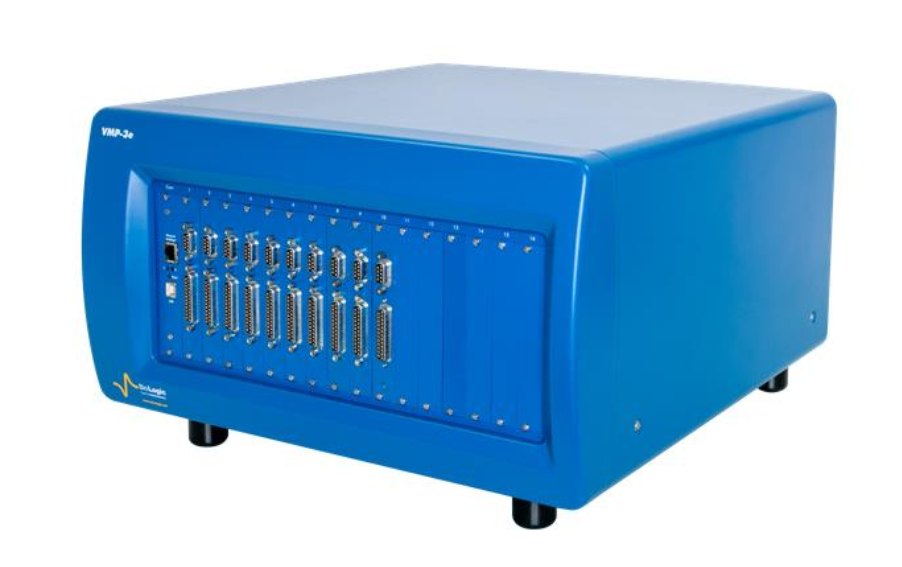
In a pack/stack of series-connected cells, the EIS of each element is measured simultaneously under load to identify faulty cells and the internal-resistance distribution; this measurement, made with the VMP3, is done today with the VMP-3e + SAM-50.
Sections of the note: Introduction · Technical Specificity of the Stack Applications · Materials and Connection · Software · Impedance Measurement of an Electrochemical Generator · Measurements on Four Batteries in Series
Current model: The VMP3 has been discontinued; its current counterpart is the 16-channel VMP-3e.
Battery – Application Note 26BCS-800 → BCS-900VMP3 → VMP-3eVSP → VSP
How are EC-Lab® and BT-Lab® graphs customised?
Axis definition with 24 mathematical functions, custom graph examples from RDE voltammetry to battery cycling; examples given with the BCS-800 apply to the BCS-900 and BT-Lab® Suite.
Sections of the note: Introduction · RDE Voltammetry Application · Battery Applications · EIS Applications · Conclusion
Current model: The BCS-800 series has been replaced by the BCS-900 series.
Current model: The VMP3 has been discontinued; its current counterpart is the 16-channel VMP-3e.
Current model: The VSP is still available in the Essential range; for energy applications the VSP-3e is recommended.
Battery – Application Note 38VSP → VSP
Dynamic resistance of a battery: how are AC (EIS) and DC (current interrupt) measurements related?
The RΔt determined by a current pulse is compared with the resistances read from EIS; which frequency the choice of Δt corresponds to and the consistency of the two methods are shown.
Sections of the note: Introduction · Experimental · Dynamic resistance determination · EIS measurement · DC/AC data comparison · One point comparison
Current model: The VSP is still available in the Essential range; for energy applications the VSP-3e is recommended.
Battery – Application Note 40MPG2 → MPG-200
How are degradation mechanisms tracked with dQ/dV (differential capacity) analysis?
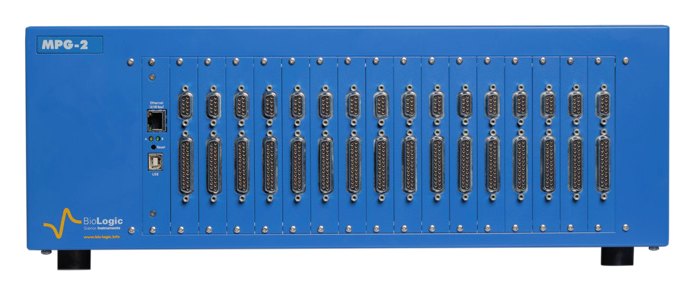
dQ/dV curves from cycling data recorded with a constant dE parameter; diagnosis of Li-ion ageing mechanisms (LLI, LAM) from peak shifts and area changes; MPG-2 example.
Sections of the note: Introduction · Experiment · Results · Conclusion
Current model: MPG2 is the former name of the current MPG-200 series (MPG-2 / MPG-205).
Battery – Application Note 46VSP → VSP
How is electrode swelling/shrinkage (dilatometry) measured during cycling?
The thickness change of a LiCoO2 electrode is recorded simultaneously with cycling using an electrochemical dilatometer; analogue-input synchronisation and data interpretation.
Sections of the note: Introduction · Set-up description · Measurements · Conclusion
Current model: The VSP is still available in the Essential range; for energy applications the VSP-3e is recommended.
Battery – Application Note 53BCS-815 → BCS-900VMP3 → VMP-3e
How are precision and accuracy ensured in Coulombic-efficiency measurement (HPC)?
Current accuracy, stability, temperature control and measurement-duration requirements for high-precision coulometry; ppm-level CE measurement with the BCS-915.
Sections of the note: Introduction · Precision and Accuracy in CE Measurements · CE Measurement · Experimental Conditions · Software Tools · Discussion
Current model: The BCS-815 has been replaced by the BCS-915.
Current model: The VMP3 has been discontinued; its current counterpart is the 16-channel VMP-3e.
Battery – Application Note 57VMP3 → VMP-3e
What is differential coulometry spectroscopy (DCS)?
The DCS tool, the statistical counterpart of dQ/dV for data recorded at constant dt; calculation, noise reduction and battery performance comparison in EC-Lab®/BT-Lab®.
Sections of the note: Introduction · Experiment · Results · Conclusion
Current model: The VMP3 has been discontinued; its current counterpart is the 16-channel VMP-3e.
How is 3-electrode battery cycling with a reference electrode done in a PAT-Cell?
Simultaneous monitoring of positive and negative electrode potentials with the lithium-metal-referenced PAT-Cell test cell; instrument connection options and EC-Lab® settings.
Sections of the note: Introduction · EXPERIMENTAL SET-UP · CYCLING DISCUSSION · FIRST CYCLE (BETWEEN 2.5 AND 4.2 V) · SECOND CYCLE (BETWEEN 2.5 AND 4.5 V) · THIRD AND FOURTH CYCLE (BETWEEN 0.0 AND 4.5 V)
Current model: The SP-240 has been discontinued; its current counterpart is the SP-300.
Current model: The SP-50 has been replaced by the SP-50e.
Current model: The SP-150 has been replaced by the SP-150e.
Current model: The VMP3 has been discontinued; its current counterpart is the 16-channel VMP-3e.
Current model: The VSP is still available in the Essential range; for energy applications the VSP-3e is recommended.
How is the behaviour of each element in a battery module/pack monitored?
A VMP-3e, SAM-50 and FlexP combination for pack cycling and individual voltage/EIS tracking of the elements; wiring diagram, safety limits and software settings.
Sections of the note: Introduction · EXPERIMENTAL SET-UP · MEASURING HARDWARE · EC-Lab® settings · The battery pack · The connection to the battery pack
Current model: MPG2 is the former name of the current MPG-200 series (MPG-2 / MPG-205).
Current model: The VMP3 has been discontinued; its current counterpart is the 16-channel VMP-3e.
Battery – Application Note 61BCS-815 → BCS-900
How is low-frequency impedance (diffusion) in batteries interpreted?
Modelling of the low-frequency region with Warburg and bounded-diffusion elements; relating diagrams obtained in native EIS with the BCS-915 to solid-state diffusion.
Sections of the note: Introduction · Impedance Results · How To Fit Data At Low Frequencies · The Issue · Q · W
Current model: The BCS-815 has been replaced by the BCS-915.
Battery – Application Note 62
How is the ohmic (internal) resistance of a battery measured with EIS?
The real-axis intercept at high frequency gives the ohmic resistance; inductive effects, cable and connection effects and practical rules for a correct reading; comparison with DCIR.
Sections of the note: Introduction · Many Ways to Measure RΩ · Current Interrupt · EIS · High Frequencies (HF) Behaviour of The Impedance of a Battery · Single Point Determination
How is a LiFePO4 electrode studied in situ with QCM?
Mass change accompanying Li insertion/extraction in an LFP electrode with a quartz crystal microbalance; simultaneous CV and mass measurement with the SP-200.
Sections of the note: Introduction · Electrode fabrication · Characterization of the clean and coated sensors in air · Theory · Results · QCM Characterization of the coated sensor in 1 M Li2SO4
Current model: For the BluQCM product group, please consult Entek.
How is the diffusion coefficient of the intercalated species determined with EIS, PITT and GITT?
Theoretical basis of the three methods and their comparative application on the same LFP electrode; measurement with the BCS-805/810/815 (today BCS-900 series) and SP-300.
Sections of the note: Introduction · Measurement methods · EIS · PITT · GITT · Experimental results
Current model: The BCS-805 has been replaced by the BCS-905.
Current model: The BCS-810 has been replaced by the BCS-910.
Current model: The BCS-815 has been replaced by the BCS-915.
Current model: The VMP3 has been discontinued; its current counterpart is the 16-channel VMP-3e.