Bio-LogicBio-Logic Science Instruments — Authorized Distributor for Türkiye
+90 (312) 437 40 77  ·  [email protected]
TR/EN
Get a Quote
Knowledge Library · 4 topics

Supercapacitors

Constant-current cycling, time constant and EIS for supercapacitor capacitance, ESR and energy/power characterisation; Ragone plots.

Electrochemistry – Application Note 6

How are the constant-power technique and a Ragone plot obtained?

Energy-power relationship with constant-power discharge (CPW); building the Ragone plot for supercapacitors and batteries in EC-Lab®.

Sections of the note: Introduction · EXPERIMENTAL PART · RESULTS AND DISCUSSION · Conclusion

Related products:EC-Lab®VMP-3e
Download PDF Source: biologic.net · Updated: November 28, 2023
Supercapacitor – Application Note 33VMP3 → VMP-3e

How is supercapacitor charge/discharge cycling (DC) done and how is capacitance calculated?

Capacitance, ESR and efficiency calculation from galvanostatic cycling; measurement with the VMP3 (today VMP-3e) and EC-Lab® process data.

Sections of the note: Introduction · Set-up description · Charge/discharge cycling · Constant power discharge · Conclusion

Current model: The VMP3 has been discontinued; its current counterpart is the 16-channel VMP-3e.
Related products:VMP-3eEC-Lab®
Download PDF Source: biologic.net · Updated: September 25, 2026
Supercapacitor – Application Note 34VMP3 → VMP-3e

How is the time constant of a supercapacitor determined with EIS?

Reading the relaxation time constant from the complex-capacitance representation (C' and C''); real and imaginary capacitance analysis in EC-Lab®.

Sections of the note: Introduction · Set-up description · Potentio technique · EIS investigations · Conclusion

Current model: The VMP3 has been discontinued; its current counterpart is the 16-channel VMP-3e.
Related products:VMP-3eEC-Lab®
Source: biologic.net · PDF (manufacturer) · Updated: July 31, 2023
Supercapacitor –  Application Note 51SP-300

How is a supercapacitor characterised by galvanostatic polarisation?

Capacitance and resistance determination by the constant-current polarisation method; measurement with the SP-300 and comparison with the cycling method.

Sections of the note: Introduction · Experimental Conditions · Results · E VS. Time Curves · Capacity Measurement · Capacitance Measurement


Related products:SP-300EC-Lab®
Download PDF Source: biologic.net · Updated: September 28, 2026

Products related to this class

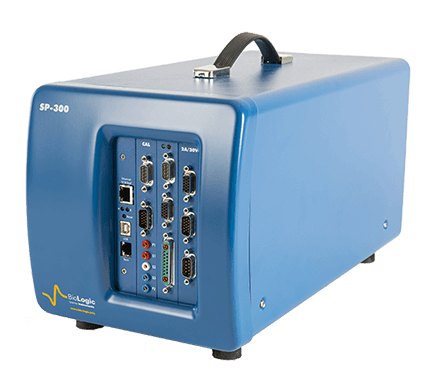
SP-300
Bio-LogicPremium

SP-300

Fast, accurate, stable and modular — grows with your research
  • 2 slots: second channel, bipotentiostat (RRDE) or internal booster
  • Internal booster boards: ±1 A/±48 V, ±2 A/±30 V, ±4 A/[-3;14] V, ±10 A/[-1;6] V
  • EIS 10 µHz – 11 MHz
VMP-3e
Bio-LogicEssential

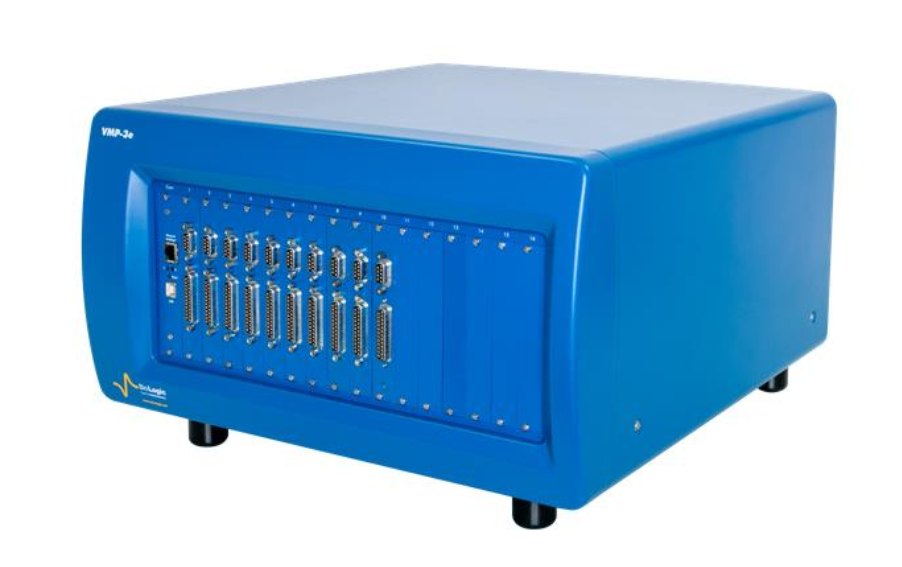
VMP-3e

The 16-channel reference workstation
  • Up to 16 channels, ±1 A per channel
  • External booster on every channel: up to 800 A
  • Multi-electrode setups with CE-to-GND mode
HCP-803
Bio-LogicEssential

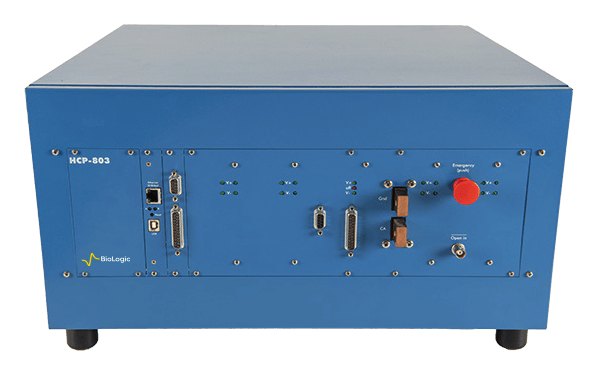
HCP-803

±80 A for supercapacitors and fuel cells
  • ±80 A, ±3 V (at 80 A)
  • EIS up to 20 kHz
  • Fuel cells/electrolyzers, supercapacitors and electroplating
EC-Lab®
Bio-Logic

EC-Lab®

Over 30 years of development: the reference software in electrochemistry
  • 80+ techniques, experiment sequence builder
  • EIS 10 µHz – 11 MHz, patented drift correction
  • Z Fit: 150+ circuits, 14 elements

Would you like to set up this measurement in your laboratory?

Contact our technical team for the suitable instrument, cell and software configuration.

Quotation and technical consulting