Electrochemistry – Application Note 6
How are the constant-power technique and a Ragone plot obtained?
Energy-power relationship with constant-power discharge (CPW); building the Ragone plot for supercapacitors and batteries in EC-Lab®.
Sections of the note: Introduction · EXPERIMENTAL PART · RESULTS AND DISCUSSION · Conclusion
Supercapacitor – Application Note 33VMP3 → VMP-3e
How is supercapacitor charge/discharge cycling (DC) done and how is capacitance calculated?
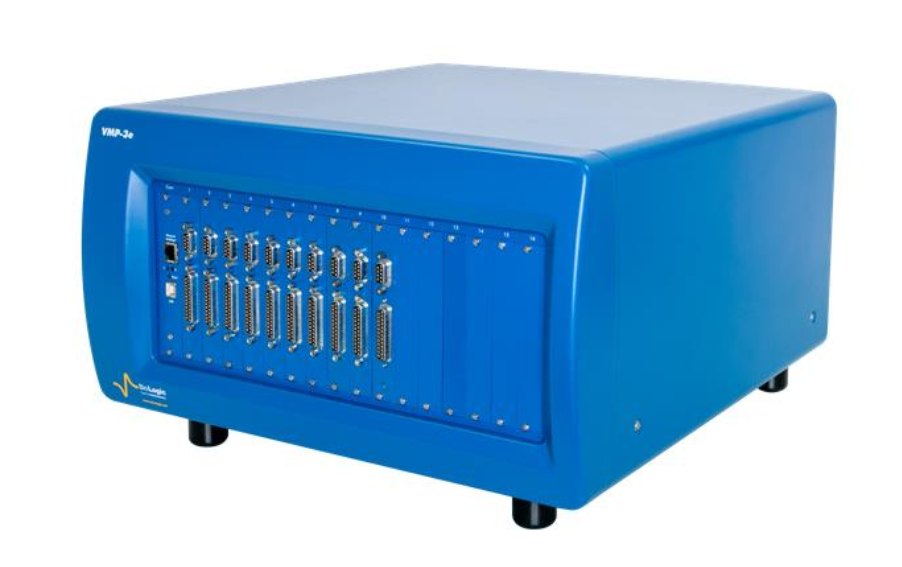
Capacitance, ESR and efficiency calculation from galvanostatic cycling; measurement with the VMP3 (today VMP-3e) and EC-Lab® process data.
Sections of the note: Introduction · Set-up description · Charge/discharge cycling · Constant power discharge · Conclusion
Current model: The VMP3 has been discontinued; its current counterpart is the 16-channel VMP-3e.
Supercapacitor – Application Note 34VMP3 → VMP-3e
How is the time constant of a supercapacitor determined with EIS?
Reading the relaxation time constant from the complex-capacitance representation (C' and C''); real and imaginary capacitance analysis in EC-Lab®.
Sections of the note: Introduction · Set-up description · Potentio technique · EIS investigations · Conclusion
Current model: The VMP3 has been discontinued; its current counterpart is the 16-channel VMP-3e.
How is a supercapacitor characterised by galvanostatic polarisation?
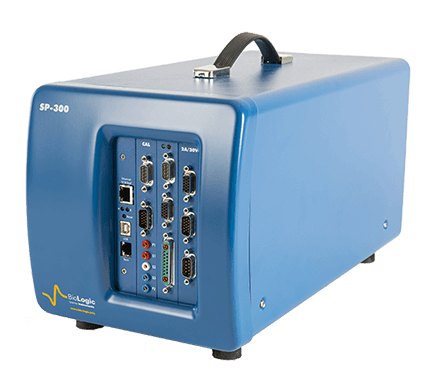
Capacitance and resistance determination by the constant-current polarisation method; measurement with the SP-300 and comparison with the cycling method.
Sections of the note: Introduction · Experimental Conditions · Results · E VS. Time Curves · Capacity Measurement · Capacitance Measurement