

What is high-precision coulometry (HPC) and why does it need an ultra-precise cycler?
A method of predicting Li-ion cell lifetime quickly by measuring the Coulombic efficiency (CE) of the first cycles with very high accuracy instead of long-term cycling, and the instrument requirements.
Key points
- Classic lifetime testing relies on long-term cycling; high current and temperature are used to accelerate it, but these conditions may not represent real use.
- HPC was developed in 2010 in Jeff Dahn's laboratory at Dalhousie University. CE = charge delivered during discharge / charge stored during the previous charge; the cell is cycled n times between defined cut-off voltages (optionally with a CV step).
- In the example the CE ranking of three cells over the first 20 cycles matches the ranking of capacity loss seen after hundreds of cycles: differences of parts per thousand in CE become large differences in lifetime.
- Requirements: current accuracy and stability for constant charge/discharge, voltage measurement accuracy for repeatable cut-off, and a precise time base for accurate charge/discharge periods and charge calculation.
- BCS-900 series: five current ranges, 18-bit resolution and a 1 ms time base; typical RMSE of CE measurements around 11 ppm (Bio-Logic AN53).
Figures
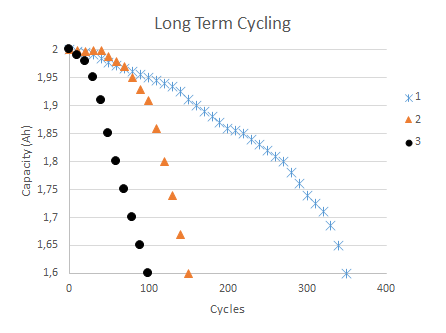
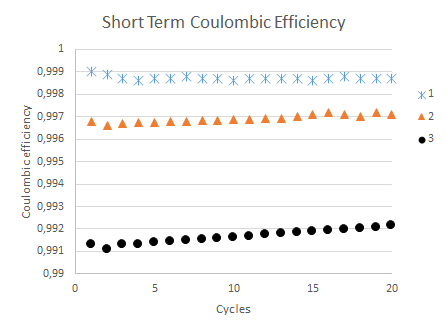
Images: Bio-Logic Science Instruments; taken from the source article.
Related application notes
Related curriculum module: Battery Testing and Characterisation
Source: Bio-Logic Learning Center, “HPC: The importance of ultra-precision battery cyclers” · Source updated: August 24, 2026
Copyright of the images and the original text belongs to Bio-Logic SAS.
Copyright of the images and the original text belongs to Bio-Logic SAS.