

How is dynamic EIS performed during battery cycling?
Static EIS waits for the cell to equilibrate and may miss real operating conditions. Dynamic EIS records spectra during charge and discharge with the perturbation superimposed on a DC current. A five-phase example protocol with ModuloBat and how to check data validity.
Key points
- Static EIS satisfies linearity, time invariance and stationarity, but may miss processes that weaken or disappear during rest, such as charge-transfer dynamics, transient diffusion, dendrite growth and lithium plating.
- Dynamic EIS does not strictly satisfy stationarity; results should be interpreted as approximations giving operational insight, not rigorous impedance values, and validated against static EIS at key states of charge (SOC).
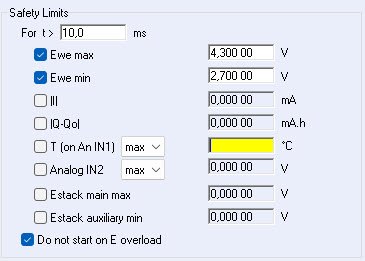
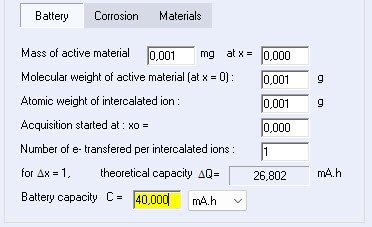
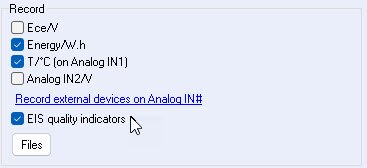
- Good practice: stable temperature, short cables, voltage and temperature safety limits suited to the chemistry, amplitude chosen from existing data or with GEIS-AA, current defined as a C-rate (by entering the capacity in 'Cell Characteristics' or determining it with the BCD technique) and EIS QI recording switched on.
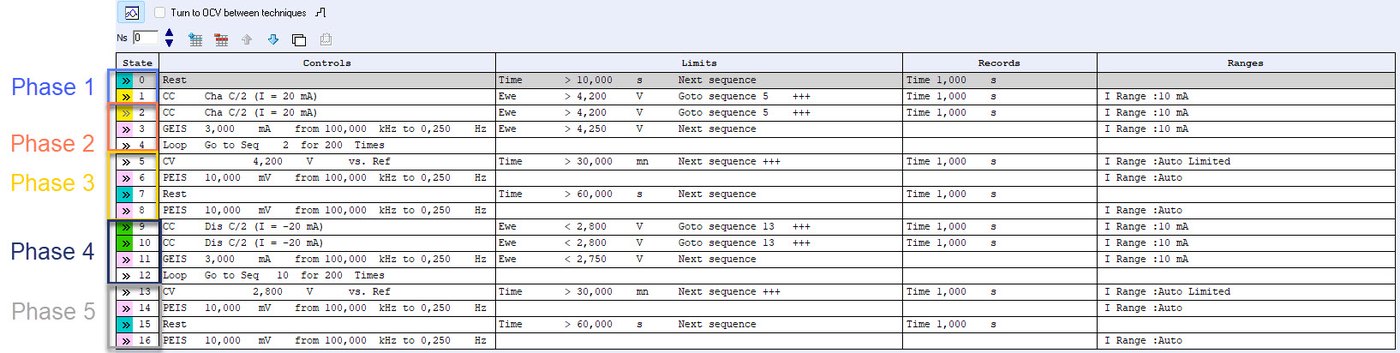
- Protocol: (1) rest and an initial current application outside the loop (to pass the transient); (2) short charge pulse + GEIS loop; (3) CV hold + PEIS, then rest + PEIS; (4) short discharge pulse + GEIS loop; (5) optionally an end-of-discharge CV hold + PEIS, then rest + PEIS.
- During GEIS the voltage limit should be slightly above the target (slightly below during discharge); the AC amplitude causes voltage excursions on either side of the DC level, so the spectrum would otherwise stop early.
- Example: LIR2032 cell (3.6 V, 40 mAh), VSP-300 and CCH-1 coin-cell holder, 20 °C. THD and NSD are mostly below 5%; only at low frequencies does NSD rise, so for full rigour this region can be excluded from analysis.
Figures
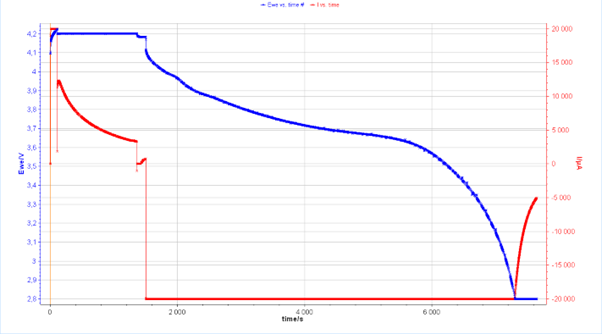
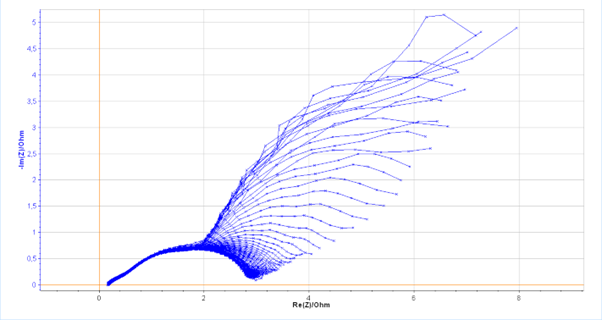
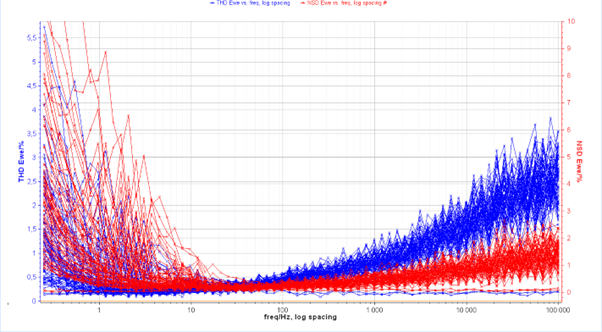
Images: Bio-Logic Science Instruments; taken from the source article.
Related application notes
- How are EC-Lab® parameters set for EIS on a Li-ion cell? Battery AN23
- What do the EIS quality indicators THD, NSD and NSR tell us? Corrosion AN64
- Potentio-EIS or galvano-EIS? Which one should be chosen in which case? Battery AN49
- How is a non-stationary EIS measurement corrected? (Battery cell example) Battery AN69-2
- White paper: Studying batteries with EIS WP Battery EIS
Related curriculum module: Electrochemical Impedance Spectroscopy (EIS)
Related products:VSP-300MPG-200 Series (MPG-2 / MPG-205)BCS-900 Series (BCS-905 / 910 / 915)Battery Cell HoldersEC-Lab®
Source: Bio-Logic Learning Center, “How to perform Dynamic EIS during Battery Cycling” · Source updated: June 17, 2026
Copyright of the images and the original text belongs to Bio-Logic SAS.
Copyright of the images and the original text belongs to Bio-Logic SAS.