

Why is EIS used in battery research?
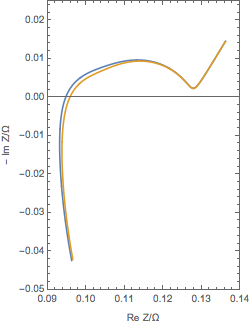
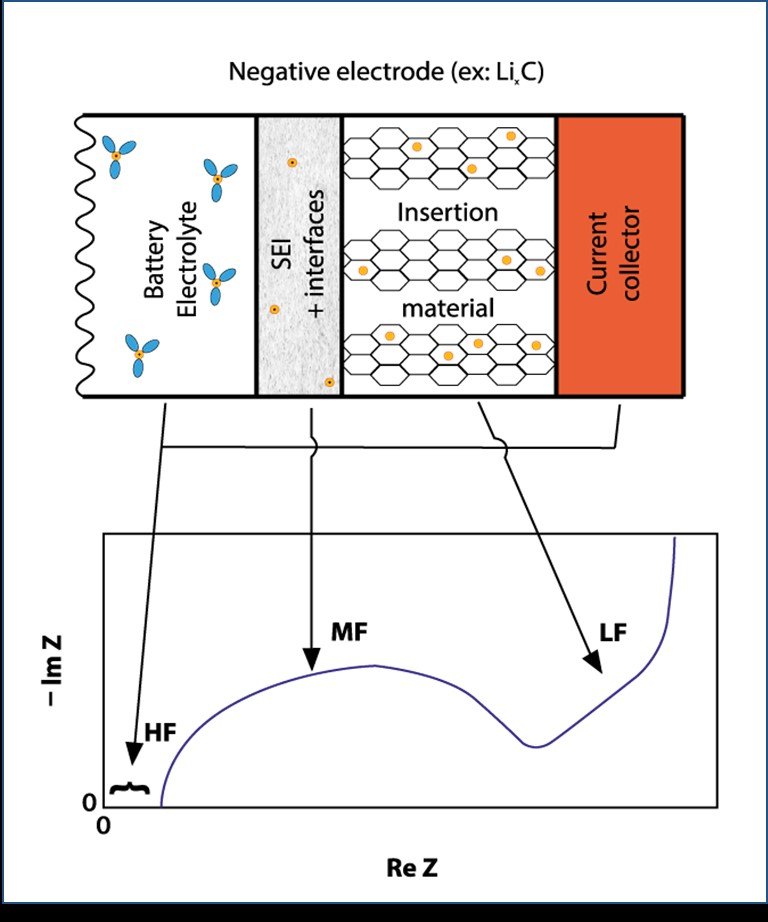
EIS allows the loss of performance during cycling to be monitored: internal resistance at high frequency, SEI and charge transfer at middle frequency, and diffusion in the insertion material at low frequency.
Key points
- High frequency: ohmic resistance of the electrolyte and internal resistance of the cell (Bio-Logic AN62).
- Middle frequency: SEI layer capacitance and charge-transfer rate at the electrode interface; the impedance of electron transfer through the SEI is an important indicator of degradation.
- Low frequency: diffusion of species in the insertion material (AN61).
- In cell Nyquist plots an inductive branch from cables and windings is often seen at high frequency; it is accounted for in the fit with elements such as La.
- EIS is available on Bio-Logic potentiostats/galvanostats and battery cyclers; Nyquist analysis is done with EC-Lab ZFit. See AN23 for parameter settings.
Figures
Images: Bio-Logic Science Instruments; taken from the source article.
Related application notes
- How are EC-Lab® parameters set for EIS on a Li-ion cell? Battery AN23
- How is low-frequency impedance (diffusion) in batteries interpreted? Battery AN61
- How is the ohmic (internal) resistance of a battery measured with EIS? Battery AN62
- White paper: Studying batteries with EIS WP Battery EIS
- When is the modified inductance element La needed? Battery AN42
Related curriculum module: Electrochemical Impedance Spectroscopy (EIS)
Source: Bio-Logic Learning Center, “Why use Electrochemical Impedance Spectroscopy (EIS) for battery research?” · Source updated: November 15, 2024
Copyright of the images and the original text belongs to Bio-Logic SAS.
Copyright of the images and the original text belongs to Bio-Logic SAS.