

How can an EIS measurement be split into sequences to save time without compromising quality?
In EC-Lab and BT-Lab an EIS technique can be split into several sequences; choosing point density, averaging and amplitude separately for each frequency region shortens the measurement. A comparison on a battery and a dummy cell.
Key points
- Reliable EIS requires the system to remain linear and stationary throughout the measurement; for time-variant systems such as batteries, corrosion and supercapacitors, shortening the measurement directly improves quality.
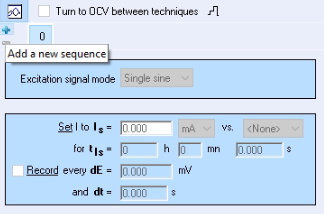
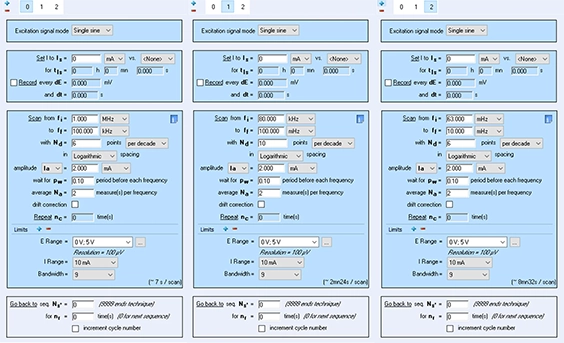
- Sequences are added with the '+' button at the top left of the technique window; points per decade, wait (Pw), frequency range and amplitude can differ in each sequence.
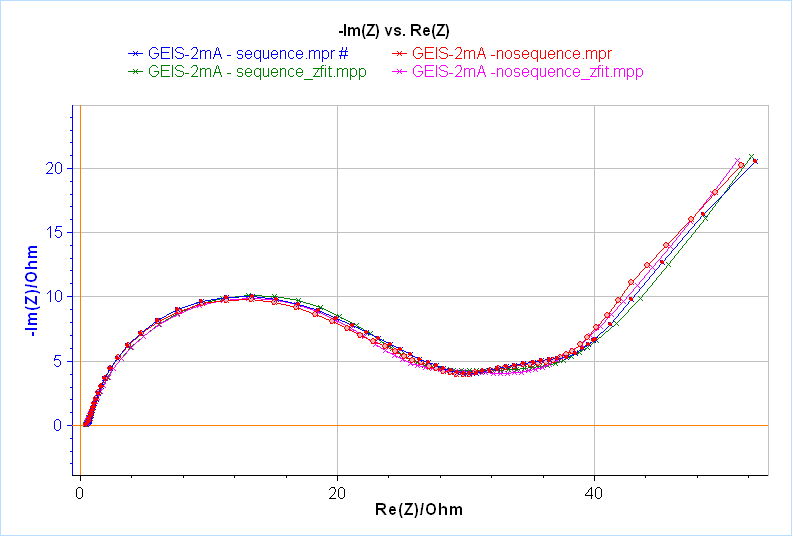
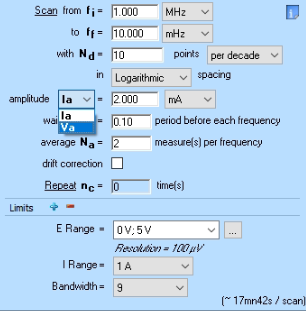
- On a LIR2032 cell, from 1 MHz to 10 mHz with Ia = 2 mA, 10 points per decade, Pw = 0.10 and Na = 2, the single-sequence measurement took 34.05 minutes while the split measurement took 21.68 minutes (about 12 minutes saved). This matters for EIS during charge/discharge.
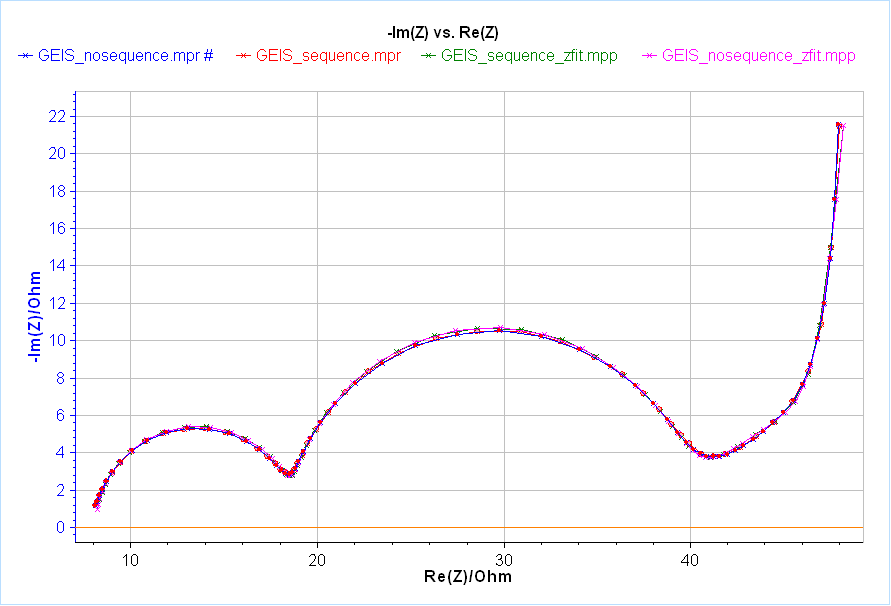
- Because battery repeatability is limited, a like-for-like comparison was made on the time-invariant DC-BCS dummy cell. With an R1 + C2/R2 + C3/R3 + M4 circuit the fit parameters are practically identical (e.g. R2 = 10.33 and 10.37 Ω); since the point counts differ, the compared χ/√N changes from 0.1302 to 0.1287.
- GEIS-AA: selecting Va instead of Ia in the amplitude menu of the GEIS technique adapts the current amplitude to deliver the target voltage amplitude across the whole frequency range. The amplitude must be large enough to stand out from noise and small enough to stay within the linear range.
Figures
Images: Bio-Logic Science Instruments; taken from the source article.
Videos

Related application notes
Related curriculum module: Electrochemical Impedance Spectroscopy (EIS)
Related products:BCS-900 Series (BCS-905 / 910 / 915)MPG-200 Series (MPG-2 / MPG-205)SP-300BT-Lab® Suite
Source: Bio-Logic Learning Center, “Split electrochemical impedance spectroscopy (EIS) experiments into multiple sequences: save time without compromising quality” · Source updated: November 18, 2024
Copyright of the images and the original text belongs to Bio-Logic SAS.
Copyright of the images and the original text belongs to Bio-Logic SAS.