

How is a corrosion system characterised by EIS? (VASP and CASP)
EIS separates the physical and chemical processes in corrosion; equivalent-circuit modelling quantifies kinetic, diffusion, passivation and adsorption processes. The impedance-based VASP and CASP methods give the corrosion parameters.
Key points
- Because measurements use a small AC amplitude they are fast and non-destructive; they must be made at steady state, satisfying the linearity and stationarity conditions.
- The main output is the corrosion current and, from it, the corrosion rate.
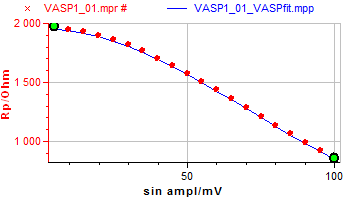
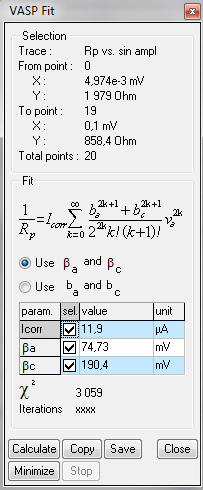
- VASP (variable amplitude sinusoidal polarisation): fitting the variation of polarisation resistance (Rp) with excitation amplitude gives Icorr, βa and βc. In the example Icorr = 11.9 µA, βa = 74.7 mV and βc = 190.4 mV (AN36).
- CASP (constant amplitude sinusoidal polarisation) is a second impedance-based method for determining corrosion parameters (AN37).
- Impedance methods give accurate results for systems with mass-transport limitation or solution ohmic drop; DC methods inevitably underestimate the corrosion rate there and need ohmic-drop compensation before measurement (AN48).
Figures
Images: Bio-Logic Science Instruments; taken from the source article.
Related application notes
- How are Rp and the Tafel coefficients determined with the VASP technique? Corrosion AN36
- How is Rp determined with the CASP technique? Corrosion AN37
- How much does ohmic drop mislead corrosion-current determination? Corrosion AN48
- How is the corrosion current determined under mass-transfer-limited corrosion? Corrosion AN47
Related curriculum module: Electrochemical Impedance Spectroscopy (EIS)
Source: Bio-Logic Learning Center, “Electrochemical characterization of a corrosion system by Impedance spectroscopy” · Source updated: September 28, 2026
Copyright of the images and the original text belongs to Bio-Logic SAS.
Copyright of the images and the original text belongs to Bio-Logic SAS.