

LEIS or ac-SECM? The differences between two local impedance techniques
Both techniques produce local impedance data and LEIS is often used as a catch-all name; but where the perturbation is applied, the resolution, the cell set-up and the nature of the analysis differ.
Key points
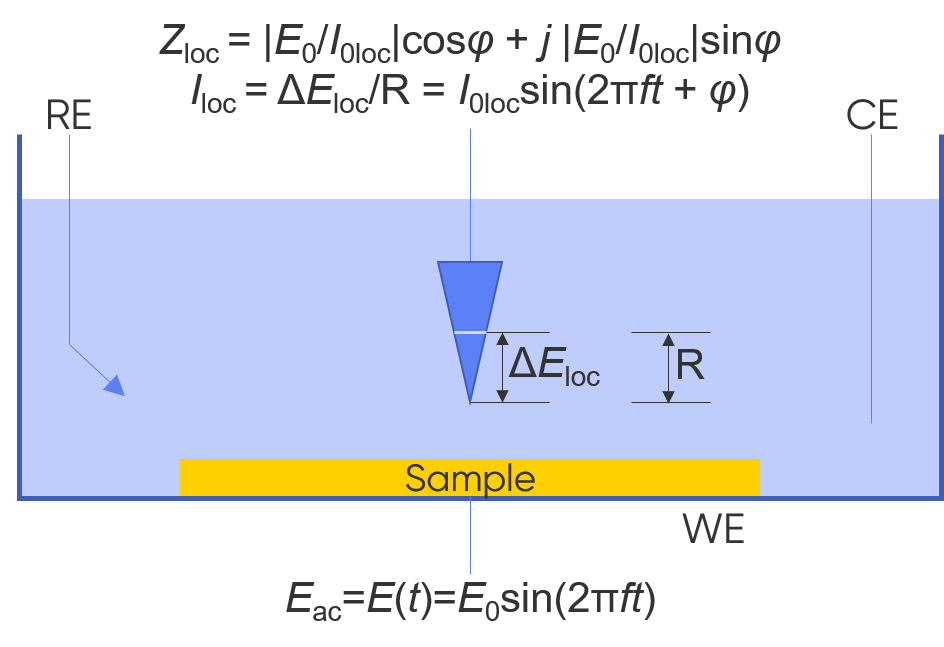
- LEIS: the ac perturbation is applied to the sample (working electrode); a five-electrode cell is used and the bi-electrode probe takes no part in the electrochemistry. Resolution is set by the diameter of the two probe electrodes and the distance between them (mm scale); the typical scan area is large.
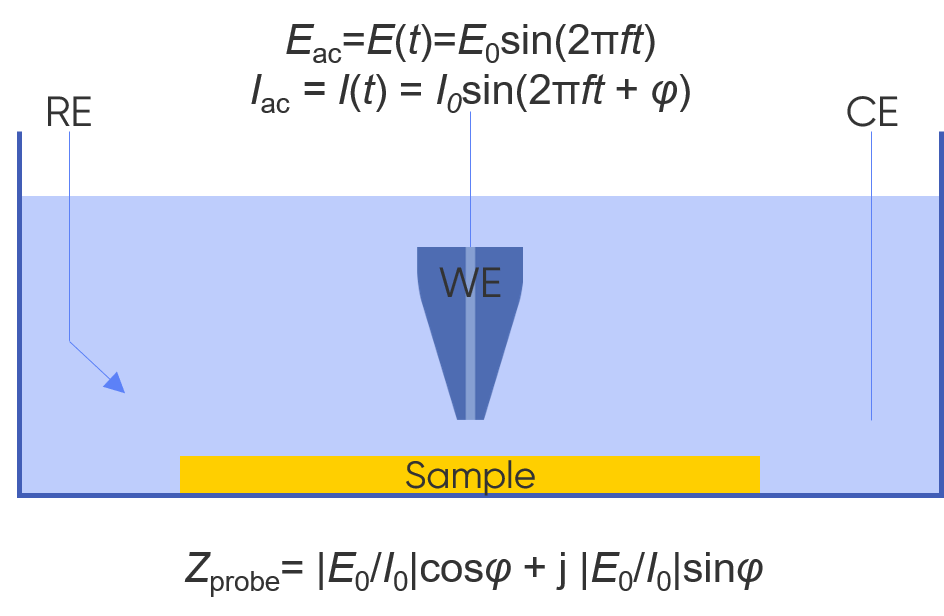
- ac-SECM: the ac perturbation is applied to the probe itself (the probe is the working electrode; in the less common direct mode it is the counter electrode); a three- or four-electrode cell, the sample is usually not connected. Resolution is set by the probe diameter (µm scale).
- LEIS gives quantitative analysis on fully conducting and coated samples; it is usually run in galvanostatic mode at constant height, with the probe positioned visually.
- ac-SECM gives qualitative analysis on samples from fully conducting to fully insulating; it is usually run in potentiostatic mode at constant height, or at constant distance with ic-SECM, with the probe positioned by an approach curve.
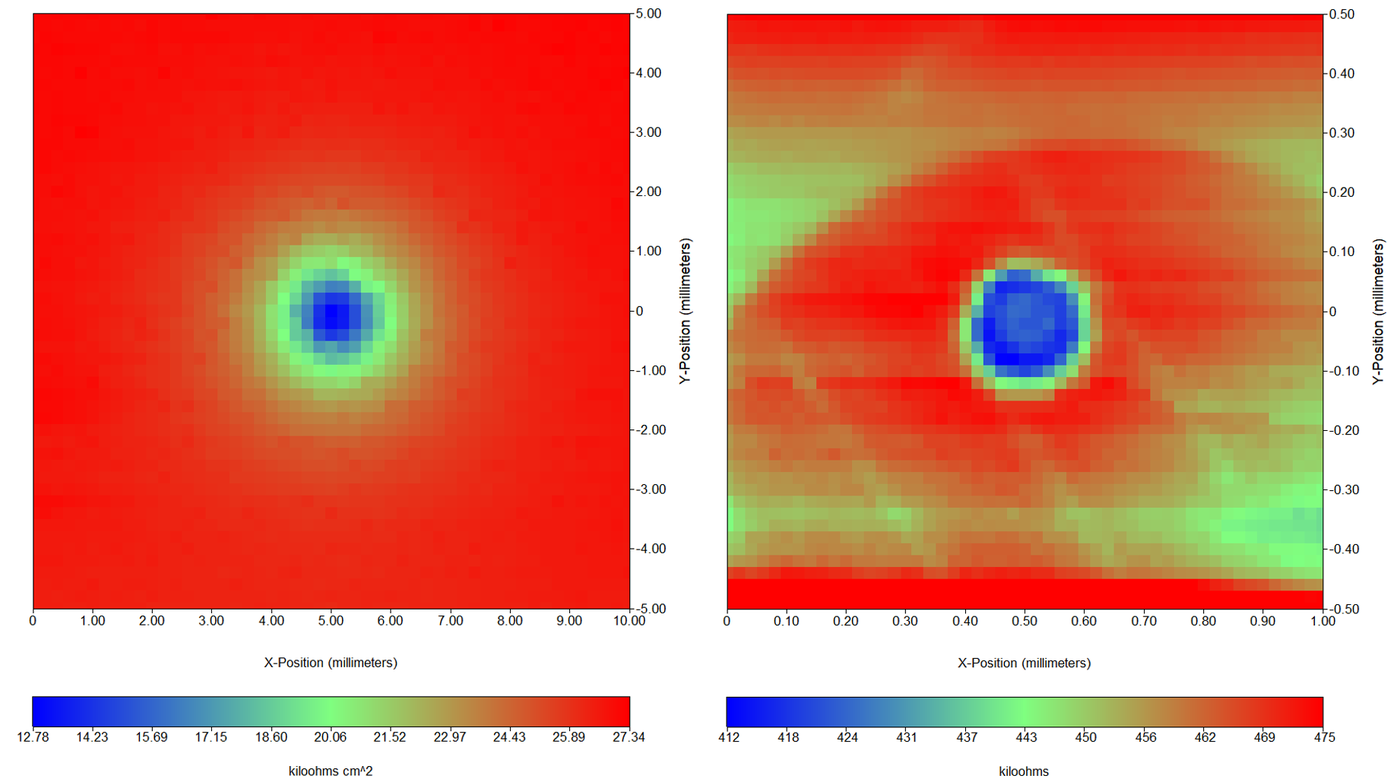
- Comparison: a 200 µm Au point-in-space sample in tap water. LEIS: 5 kHz, 10 µA ac, 0 A dc at the sample. ac-SECM: 50 kHz, 100 mV ac, 0 V dc vs OCP at a 10 µm probe. Both show the low-impedance region over the sample; ac-SECM resolves much finer detail.
Figures
Images: Bio-Logic Science Instruments; taken from the source article.
Related application notes
- How are battery electrode materials studied in non-aqueous electrolyte with ac-SECM? Scanning Probes AN7
- dc- and ac-SECM measurements on Si nanowire arrays Scanning Probes AN10
- How is a nanopatterned gold sample measured with ic-/ac-SECM? Scanning Probes AN11
Related curriculum module: Electrochemical Impedance Spectroscopy (EIS)
Related products:M470
Source: Bio-Logic Learning Center, “LEIS or ac-SECM?” · Source updated: October 28, 2025
Copyright of the images and the original text belongs to Bio-Logic SAS.
Copyright of the images and the original text belongs to Bio-Logic SAS.