

What is local electrochemical impedance spectroscopy (LEIS) and how does it work?
Instead of the surface average given by bulk EIS, LEIS measures the local impedance of a sample: a map at one frequency or a full spectrum at a fixed point. The principle, hardware and applications of the technique introduced in 1992 by Lillard, Moran and Isaacs.
Key points
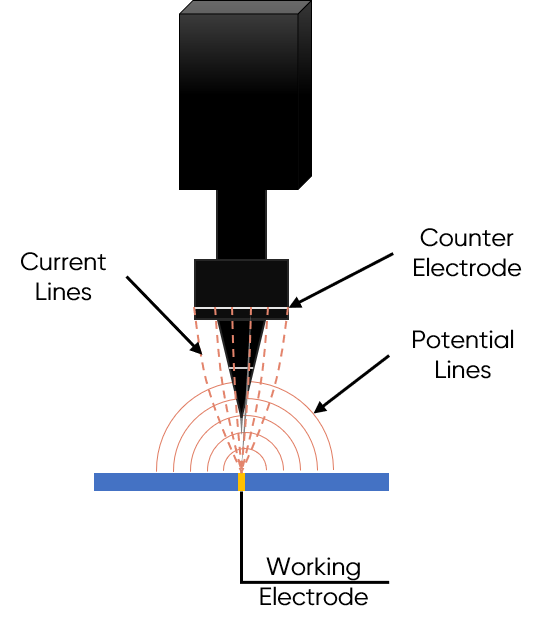
- A sine voltage or current is applied to the sample; ac current flows in solution and a potential gradient develops above the sample. A bi-electrode probe measures the ac potential difference at two points a known height apart; the local current is obtained with Ohm's law, and the local impedance from it.
- Five-electrode cell: the classic three-electrode set-up with the sample as working electrode, plus the two electrodes of the probe.
- Two experiment types: line or area scans at one frequency (LEIM, local electrochemical impedance mapping) to locate areas of interest; then a frequency sweep at a fixed x,y point to record a full local spectrum.
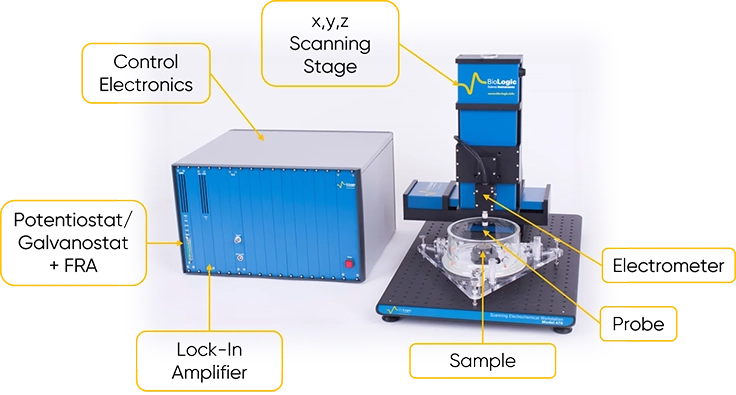
- Hardware: control electronics, x,y,z scanning stage, potentiostat/galvanostat + FRA, electrometer, lock-in amplifier and probe.
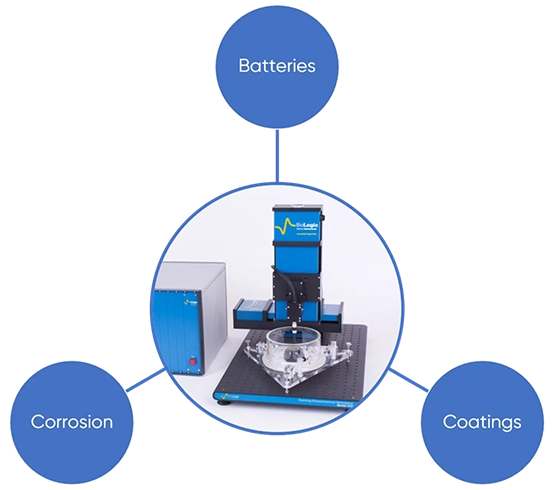
- Applications: self-healing (smart) coatings, underfilm corrosion, the effect of alloy content and external stress on corrosion, and the effect of surface treatments on battery electrodes.
Figures
Images: Bio-Logic Science Instruments; taken from the source article.
Related application notes
- Advantages of intermittent-contact (ic) SECM: two corrosion examples Scanning Probes AN6
- How are battery electrode materials studied in non-aqueous electrolyte with ac-SECM? Scanning Probes AN7
Related curriculum module: Electrochemical Impedance Spectroscopy (EIS)
Source: Bio-Logic Learning Center, “LEIS101: An Introduction to Local Electrochemical Impedance Spectroscopy” · Source updated: September 25, 2026
Copyright of the images and the original text belongs to Bio-Logic SAS.
Copyright of the images and the original text belongs to Bio-Logic SAS.