

What is the easiest way to obtain a diffusion coefficient with EIS on a rotating disk electrode?
A single EIS spectrum recorded at open-circuit potential on an RDE and fitted with the Winf element gives the diffusion coefficient of the redox species (assuming both species have the same D).
Key points
- On an RDE the faradaic current depends on the electron-transfer rate and the concentration of species reaching the interface; the concentration in turn depends on the rotation rate (convection) and the diffusion coefficient.
- Obtaining D with the bounded (convective) diffusion element Wδ requires measurements at several rotation rates and post-fit processing.
- The Winf element, an analytical approximation of Wδ, gives D directly from one measurement at one rotation rate and one fit; the method is detailed in Bio-Logic AN66.
- At 0 rpm diffusion is semi-infinite and the only stationary point is the OCP; with rotation, any point of the I-E curve can be considered stationary.
Figures
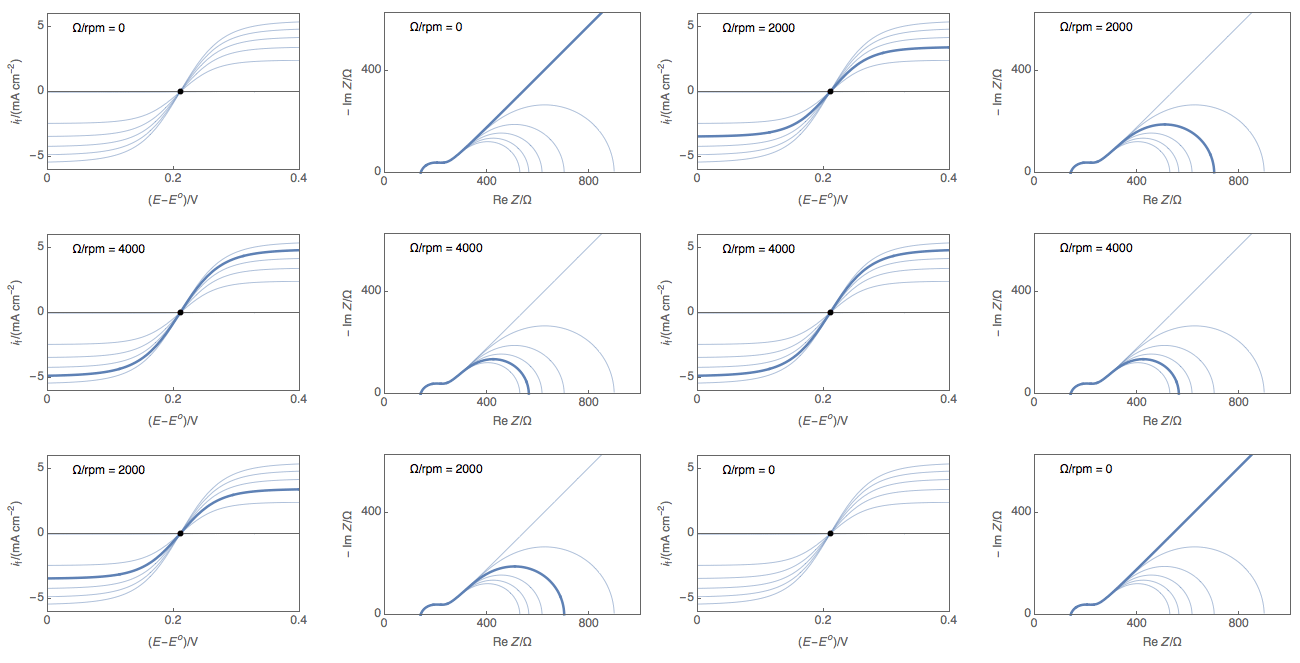
Images: Bio-Logic Science Instruments; taken from the source article.
Related application notes
Related curriculum module: Electrochemical Impedance Spectroscopy (EIS)
Source: Bio-Logic Learning Center, “The easy way to D – the diffusion coefficient” · Source updated: November 22, 2024
Copyright of the images and the original text belongs to Bio-Logic SAS.
Copyright of the images and the original text belongs to Bio-Logic SAS.