

How is EIS measurement quality verified on high-power batteries?
The power stage needed for high current slows the response, while high-frequency EIS needs a fast galvanostat. Instrument and booster combinations are compared on a 94 Ah cell using the THD of the excitation current.
Key points
- Analogy: it is hard for a vehicle to be as powerful as a truck and as fast as a race car. The instrument and its settings must be balanced for the test and the device under test.
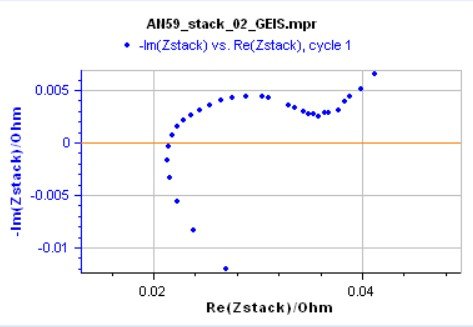
- GEIS can be performed on a battery stack with an Essential-range potentiostat and a FlexP external booster (details in Bio-Logic AN59).
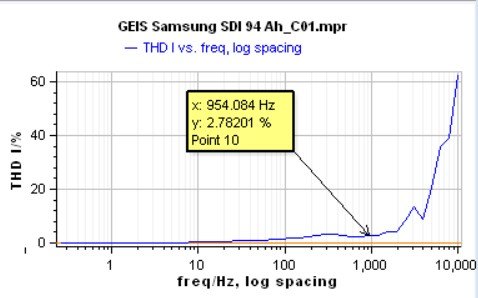
- Here THD is used on the excitation current (THD I) to measure the linearity of the instrument rather than the system, avoiding misinterpretation caused by battery behaviour.
- With an SP-150e + FlexP 0012 at 10 A amplitude on a 94 Ah cell (about C/10): THD is below a few percent from 0.1 Hz to 1 kHz and 2.8% at 1 kHz; non-linearity begins above about 2 kHz. It is suitable for single-frequency 1 kHz AC internal resistance tests.
- THD I at 1 kHz and 10 A: SP-150e + FlexP 0012 (200 A) 2.8%; HCP-1005 (100 A) 2.9%; BP-300 (10 A) 0.1%. THD increases with power, but all values are low enough for reliable measurements.
Figures

Images: Bio-Logic Science Instruments; taken from the source article.
Related application notes
- How is the behaviour of each element in a battery module/pack monitored? Energy Storage AN59
- How is the ohmic (internal) resistance of a battery measured with EIS? Battery AN62
- What do the EIS quality indicators THD, NSD and NSR tell us? Corrosion AN64
- Dynamic resistance of a battery: how are AC (EIS) and DC (current interrupt) measurements related? Battery AN38
Related curriculum module: Electrochemical Impedance Spectroscopy (EIS)
Source: Bio-Logic Learning Center, “Ensuring the quality of Electrochemical Impedance Spectroscopy measurements on high-power systems” · Source updated: November 18, 2024
Copyright of the images and the original text belongs to Bio-Logic SAS.
Copyright of the images and the original text belongs to Bio-Logic SAS.