

How is impedance data simulated with Z Sim?
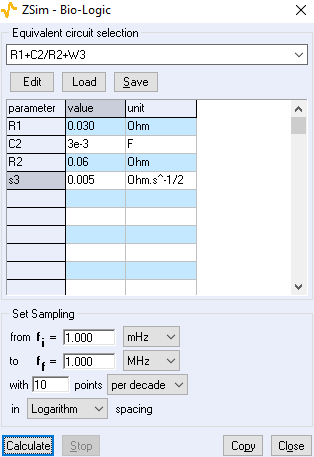
Z Sim in EC-Lab and BT-Lab generates impedance data over a chosen frequency range from a selected equivalent circuit and its parameters; it allows hypotheses to be tested without measuring, in research and in teaching.
Key points
- The equivalent circuit is selected or created with the text or graphic editor (ZFit tutorial video 3).
- The frequency range and sampling are set: total points over the whole range or points per decade; linear or logarithmic spacing.
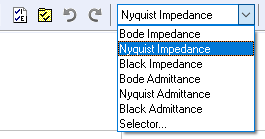
- 'Calculate' runs the simulation; the result can be switched to Nyquist, Bode, Black or admittance representations.
- It is especially useful for studying low-frequency behaviour: a measurement from 1 MHz to 10 µHz with 6 frequencies per decade can exceed 100 hours, whereas the simulation is instantaneous and has no time-variance problem (see AN61).
- It is also used to study the effect of high-frequency inductance on ohmic-drop determination.
Figures
Images: Bio-Logic Science Instruments; taken from the source article.
Videos

Related application notes
- How is low-frequency impedance (diffusion) in batteries interpreted? Battery AN61
- How is the ohmic (internal) resistance of a battery measured with EIS? Battery AN62
- When is the modified inductance element La needed? Battery AN42
- What is an equivalent circuit, and how is it built and fitted with Z Fit? Battery AN14
Related curriculum module: Electrochemical Impedance Spectroscopy (EIS)
Source: Bio-Logic Learning Center, “Investigation of impedance measurements using the Z Sim tool (Electrochemistry Basics Series)” · Source updated: November 18, 2024
Copyright of the images and the original text belongs to Bio-Logic SAS.
Copyright of the images and the original text belongs to Bio-Logic SAS.